/ Interior
~ 5 min
Published: 19/12/2025
A well-considered interplay of tones and textures can turn a space into a work of art, while imbalance is capable of undermining even the boldest concept.
In our projects, we favor veneer, engineered veneer, and solid wood from noble species — materials that allow us to create truly distinctive surfaces. In this article, we share the key principles of working with wood that form the foundation of Studia 54 ® projects and help us shape balanced, refined interiors.

How to choose wood tones in an interior
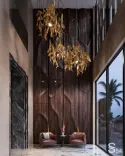
Wood, much like color, has its own “temperature”. Warm palettes traditionally include rich, deep tones: Italian walnut with its honeyed undertones, cedar, cherry, and light oak. These species create an atmosphere of comfort, intimacy, and hospitality.
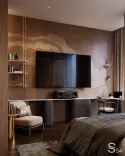

In contrast, cooler tones include wenge, smoky shimo ash, as well as rustic and Wellington oak with a subtle greenish undertone.
We do not recommend mixing different wood species within a single space. In such cases, engineered veneer is a more refined solution — thin, dyed wood layers with a wide tonal range that can be combined freely. Thanks to this rich palette, it becomes possible to create unique compositions every time.
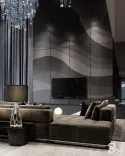
For example, in a Czech interior project, we designed a wall panel using three veneer tones: light bianche notti #01q, medium bianche notti #007s, and the darkest bianche notti #115q. The resulting wave-like pattern softens the space, adding a sense of flow and calm.

Materials that pair beautifully with veneer in interior design
Wood veneer works seamlessly with a wide range of premium materials. One of the most timeless and fail-safe combinations is veneer paired with natural stone — onyx, quartzite, or travertine. The light, cool surface of stone perfectly offsets the warmth of wood grain, creating a refined and expressive contrast.
Equally striking is the dialogue between wood and metal. Brass details — handles, profiles, lighting bases — introduce a subtle sheen and elevate the interior, accentuating the natural beauty and depth of the wood.


The wall is decorated with milling
Veneer also pairs beautifully with natural leather. Below, you can see a carefully balanced composition of materials working in harmony: a mirror finished in leather with brass inlays, a backlit onyx basin, and veneered facades. On either side, the storage units feature facades that combine leather with veneer inlays finished in a two-tone lacquer. This technique allows the veneer to achieve a refined glossy effect, adding depth and sophistication to the overall composition.
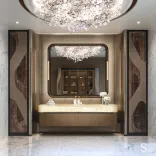

In bathrooms, we recommend using a single moisture-resistant wood species — oak or walnut with high-quality protective treatment. This approach ensures durability while preserving the refined appearance of natural wood in a high-humidity environment.
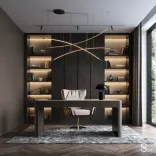
Another example of combining leather and veneer can be seen in the client’s home office in the Czech Republic. We enhanced the hinged facades with custom milling, while the back panels of the open shelving were upholstered in leather. Integrated perimeter lighting was added to create a subtle play of light and shadow, emphasizing depth and texture.

How lighting changes the perception of wood
Lighting is one of the most powerful tools for transforming how wood tones are perceived. We explore lighting design in greater detail in this article.
Warm lighting enhances the golden and reddish undertones of woods such as cherry or walnut, making them deeper. Cooler light can neutralize yellow hues, but it also risks turning warm tones into lifeless greys, while exaggerating the coolness of colder shades.
That is why we recommend using neutral color temperatures and designing layered lighting scenarios. Wood absorbs light, so it is important to work with wall sconces, concealed niche lighting, and accent spotlights that highlight texture and create a nuanced play of light and shadow.
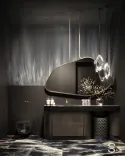
For example, in one of our Indonesian projects, we created the illusion of a gradient-painted wall. In reality, the effect was achieved purely through lighting: wall sconces interacting with a dark multiveneer surface. This technique transformed the wall into a carefully illuminated art object.

In Studia 54 ® projects, we treat wood as a material that brings spaces to life and adds depth and movement. When working with it, maintaining color balance, designing layered lighting scenarios, and pairing wood with other premium materials — stone, metal, and leather — is essential.
This holistic approach allows Studia 54 ® to transform wood from a finishing material into a powerful design instrument, shaping interiors that inspire and resonate.