About the project:
~ 10 min
Area:
2,500 m²
Project type:
Architectural design
Climate:
Nord house
Location:
Hungary
Architecture and garden as a single idea
The landscape and architecture of this project were developed in parallel. The clients dreamed of a 2,500 m2 residence inspired by Japanese culture, but adapted to the climate and lifestyle in Hungary. Therefore, work on the garden began at the stage of formation of the architectural concept.
For the Japanese tradition, this connection is fundamental: the location of the house, the views from the windows, terraces and walking routes are always considered together. Already at the architectural design stage, we imagined how the garden would open up, what landscapes would appear from the main rooms, and how nature would become part of the owners' daily lives.
Inspired by Japanese culture and the experience of working on the Satori project in Moscow, we have collected in this garden many elements without which it is difficult to imagine a traditional Japanese landscape: dry streams, rock gardens, islands among the water, gazebos for relaxation, cascading waterfalls and winding walking routes. The rosary, which became a separate wish of the customers, complemented this composition and brought its own character to it.


Miegakure — the art of gradually opening up space
One of the key principles of the project was Miegakure (見え隠れ), a Japanese aesthetic technique based on the gradual opening of space during movement.
In a traditional Japanese garden, it is impossible to see the entire composition at once. New species appear sequentially: a pond opens around a bend in the path, and a rock garden opens behind a canopy of trees.
This principle is implemented in the project through winding walking routes, island compositions, multi-layered landscaping and carefully constructed viewpoints. Due to this, the garden is perceived to be much larger than its actual size and is constantly changing depending on the route.


The principles of the Japanese garden in a modern interpretation
The main source of inspiration for the creation of the project was the traditional Japanese Kaiyu-shiki walking garden, a type of garden designed for leisurely walks and contemplation.
In such gardens, it is not the individual object that is important, but the sequence of impressions. The space opens up gradually, and each route forms its own perception scenario.
We tried to preserve this approach by complementing it with modern solutions and proprietary Studia 54 techniques. This is how water compositions, island recreation areas and a hearth located directly above the water surface appeared in the project.


At the same time, all elements of the garden are subordinated to the basic principles of Japanese aesthetics: respect for natural forms, attention to detail and the desire to create a sense of tranquility and naturalness.
The philosophy of the Five Elements
In Japanese tradition, water is considered a symbol of movement, time and the continuous change of nature. That is why it has become the basis of the entire landscape composition.
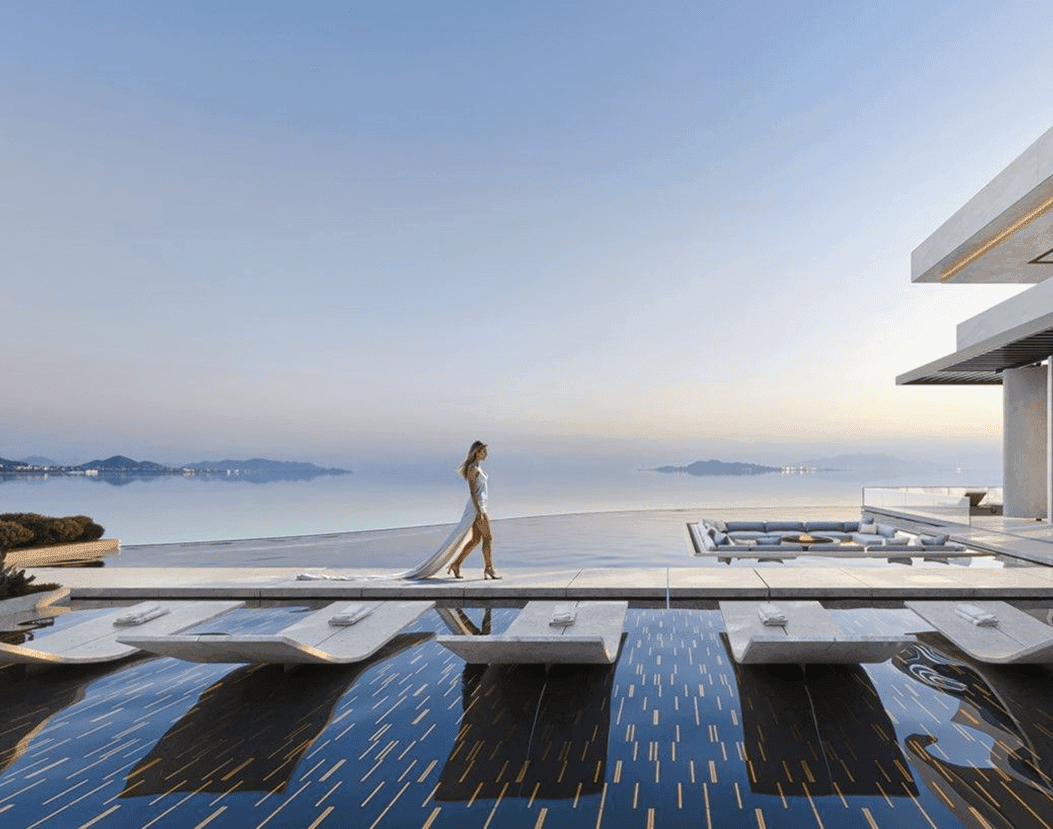
At the request of the customers, the water surfaces run through the entire site, connecting various functional zones. They surround the house, form island compositions and become an important zoning tool.
A special role is played by the island system that runs through the entire project. Trees and shrubs planted on individual islands create a sense of the natural landscape and enhance the connection of architecture with the environment.
One of the most expressive solutions was the terrace, which visually continues in one of the islands. Thanks to this, the boundary between architecture and the garden practically disappears.


Along with water, one of the main elements of a Japanese garden is a stone. Traditionally, it symbolizes sustainability, longevity and connection with the natural landscape.
The project uses stones of various sizes and textures. Large boulders form accent compositions and act as independent art objects. The medium fraction is used in paving paths, and the fine stone is used for decorative filling and decoration of individual garden areas, including “dry streams".
Special attention is paid to stone compositions that were created according to the principles of Japanese garden art, where not only the shape and size of each element are important, but also their mutual arrangement.


Organization of the site
The plot has an elongated shape and borders the road on three sides. The planning structure was built in such a way as to ensure comfortable logistics and a high level of privacy.
The main entrance is located on the south side of the site. A separate entrance leads to the underground parking on the east side, and an independent entrance is provided for the maintenance staff.
The house occupies a central position on the territory and is surrounded by a system of ponds, terraces, stone gardens and landscaped spaces. This location allows for maximum use of the site's view characteristics and provides beautiful vistas from the main rooms of the residence.


Walking route through the garden
All pedestrian paths are combined into a circular route that connects the main areas of the site.
The main walking path is made of granite and passes through the most picturesque points of the garden. In some places, the route crosses the water using stepping stones, a technique that is often found in Japanese gardens and allows you to feel closer contact with nature.
During the walk, the views are constantly changing: island compositions, water surfaces, decorative waterfalls and recreation areas are revealed. This approach makes moving around the site part of the overall impression of the garden.


Architectural precision, private living scenarios, and flawless execution


The Oriental Garden
The eastern part of the site is adjacent to the master block and is the most private area of the residence.
The main views here are focused on the water surface, island compositions and stone gardens. Nearby there is a terrace with access to the water, a recreation area and a playground with a fireplace.
This part of the garden is designed for relaxing and contemplation, so the silence, regularity and proximity to nature characteristic of a Japanese garden are especially clearly felt here.


The Northern Garden
The northern garden is connected to the kitchen, dining room, living room and glazed terrace, therefore it becomes the main space for everyday use.
The composition is built around stone gardens and cascading waterfalls. All waterfalls are integrated into a common engineering system and create a soft sound background that helps isolate the site from the outside environment and enhances the feeling of privacy.
The panoramic windows of the house offer views of water, stone and greenery, making the landscape a full-fledged part of the architectural concept.


Waterfall system
The waterfalls are integrated into the overall structure of the site as a single engineering complex.
There is a vertical waterfall along the retaining wall in the descent area to the underground parking. It becomes an expressive element of the route and accompanies the movement of the car along the ramp.


Additional island water compositions greet guests at the main entrance, immediately introducing them to the overall aesthetics of the site.
Pergolas and places to relax
Additional chamber spaces are provided for recreation on the territory. One of them was a pergola with swings, located in the garden and oriented to picturesque viewpoints.
Such elements are typical of modern interpretations of Japanese gardens, where the opportunity to stop and observe nature and the changing seasons plays an important role.


Plants and seasonality
One of the features of the Japanese garden is the attention to seasonal changes. Its expressiveness is based not so much on the bright blooming, as on the variety of textures, shades of greenery and the changing appearance of plants throughout the year.
When selecting plants, we tried to preserve the Japanese character of the garden, while adapting it to the climatic conditions of Hungary. The project uses ginnala maple, white roses, pachysandra and ornamental shrubs that are resistant to the local climate.


A special place is occupied by pine trees formed in the technique of nivaki. In the Japanese tradition, such a haircut helps to emphasize the natural plasticity of wood and create a sense of age, maturity and harmonious interaction of man with nature.
The multi-level structure of the plantings allows the garden to remain expressive at any time of the year and makes it interesting both during walks and when viewed from the windows of the house.


The Rose Garden
A separate wish of the customer was the creation of a rose garden. Three most favorable zones of the site with optimal lighting and microclimate conditions were selected for him.
White roses become a delicate accent in the overall palette of the garden and blend seamlessly with the restrained aesthetics of the Japanese landscape.


Evening image of the garden
After sunset, the landscape opens up in a new way thanks to a multi-level lighting system made in the tradition of Japanese aesthetics.
The site uses traditional Japanese lanterns, hidden illumination of tree crowns, accent lighting of shrubs and local illumination of recreation areas. The light helps to emphasize the texture of the stone, reflections on the water and silhouettes of plants, while maintaining a soft and calm atmosphere.
As in the daytime, the garden does not open completely from one point. The light gradually guides a person along the route, creating new impressions and allowing them to perceive a familiar space differently each time.


We always especially appreciate projects where we can work on architecture and landscape at the same time, creating a holistic living environment. This project has become just such an experience.
On a 2,500 m² plot, we managed to create a landscape in which the principles of Japanese garden art received a modern interpretation and were adapted to the conditions of Hungary. Water, stone, architecture and plants form a sequence of carefully thought-out spaces, each of which reveals itself in its own way and offers its own scenario of interaction with nature.
The garden is designed as a place for leisurely walks, contemplation and relaxation — a space that changes with the time of day and the seasons, maintaining its expressiveness all year round. Thanks to an integrated approach to the design of architecture and landscape, the residence is perceived as an integral living environment, where the boundary between the house and nature becomes almost invisible.